Discover 10 engaging STEM projects students can build at school to develop creativity, problem-solving, scientific thinking, and practical skills through hands-on learning.
STEM education combines Science, Technology, Engineering, and Mathematics to help students understand how concepts learned in the classroom can be applied to real-world problems.
Instead of simply reading about scientific principles, students can learn by building, testing, modifying, and experimenting with their own projects.
School STEM projects encourage curiosity, teamwork, creativity, critical thinking, and problem-solving skills. They can also make science and mathematics more engaging for students.
Here are 10 interesting STEM projects that students can build in school.
1. Water Filtration Model
A simple water filtration model is an excellent project for understanding the principles of filtration and water purification.
Students can create a basic filter using materials such as:
- Plastic bottles
- Sand
- Gravel
- Cotton
- Activated charcoal
- Water
The project demonstrates how different layers can help remove visible impurities from water.
STEM concepts: Environmental science, filtration, material science, and engineering.
Important: Filtered water from a school demonstration should not be assumed to be safe for drinking.
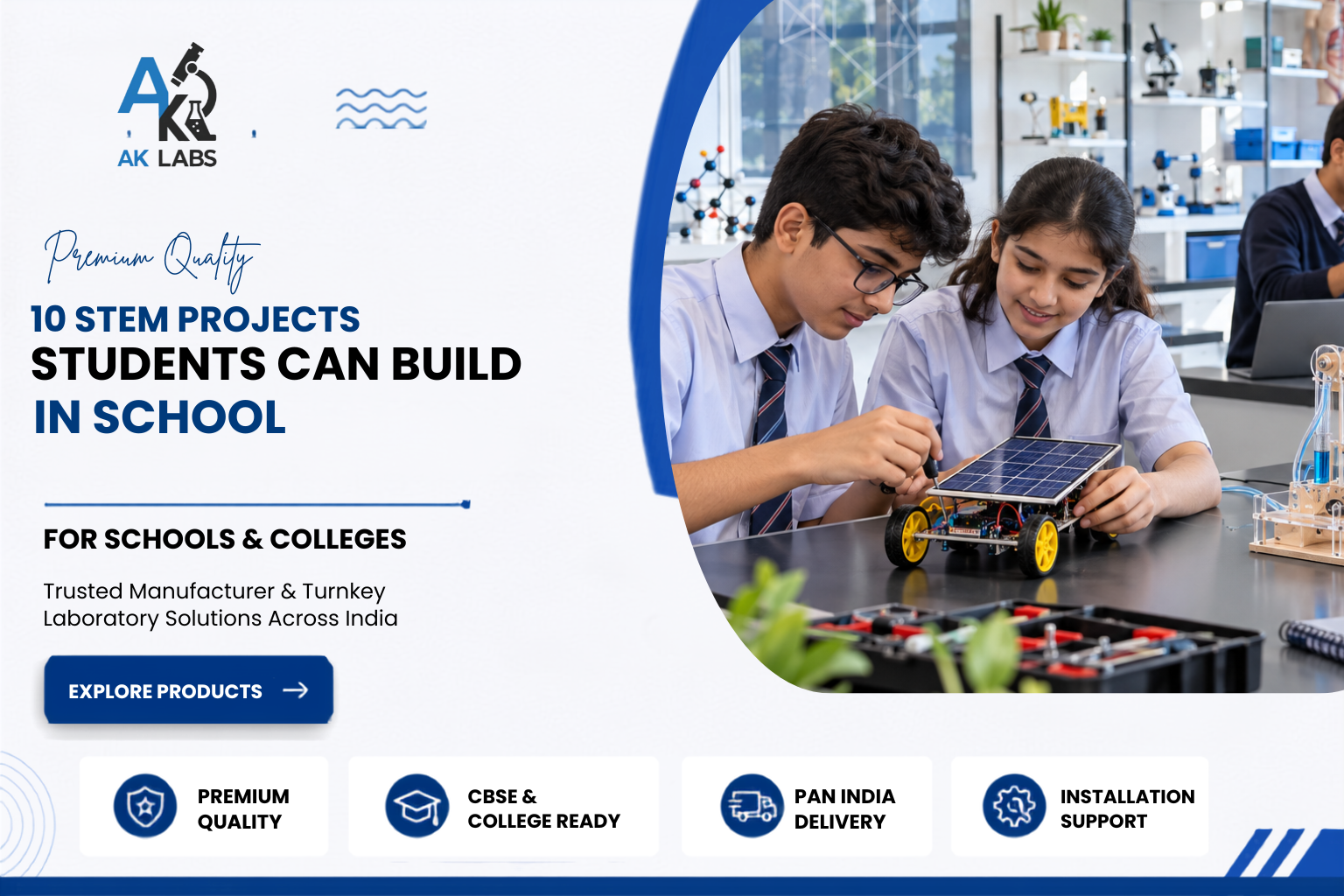
2. Mini Solar-Powered Car
A solar-powered car introduces students to renewable energy and basic electrical circuits.
Students can build a small vehicle using:
- Small solar panel
- DC motor
- Wheels
- Wires
- Lightweight chassis
When sunlight falls on the solar panel, electrical energy can power the motor and move the vehicle.
STEM concepts: Solar energy, electricity, engineering, and mechanical movement.
3. Hydraulic Lift Model
A hydraulic lift is a fascinating project for demonstrating how fluid pressure can be used to produce mechanical movement.
Students can build a small lifting mechanism using syringes, tubing, water, and a simple platform.
By pushing one syringe, pressure is transferred through the liquid to another syringe, causing the platform to move.
STEM concepts: Fluid pressure, force, mechanical systems, and engineering.
4. Simple Electric Motor
Building a basic electric motor can help students understand how electrical energy can be converted into mechanical energy.
A simple classroom model can include:
- Insulated copper wire
- Battery
- Magnet
- Coil
- Connecting wires
The project gives students an introduction to electromagnetism and motor principles.
STEM concepts: Electricity, magnetism, energy conversion, and Physics.
5. Automatic Plant Watering System
Students can combine electronics and environmental science to create an automatic plant watering system.
A basic system can use:
- Soil moisture sensor
- Microcontroller
- Small water pump
- Tubing
- Plant pot
The sensor detects the moisture level of the soil and can trigger the pump when the soil becomes too dry.
STEM concepts: Sensors, automation, programming, electronics, and environmental science.
6. Wind Turbine Model
A mini wind turbine helps students explore renewable energy and electricity generation.
Students can design blades from lightweight materials and connect them to a small motor or generator.
When the blades rotate due to moving air, mechanical energy can be converted into electrical energy.
STEM concepts: Wind energy, energy conversion, engineering, and Physics.
7. Smart Traffic Light
A miniature traffic-light system is a great introduction to programming and automation.
Students can create a model road intersection using LEDs and a microcontroller.
The lights can be programmed to change automatically according to a specific sequence.
More advanced students can add sensors to detect vehicles or pedestrians.
STEM concepts: Programming, electronics, automation, and logical thinking.
8. Earthquake-Resistant Building Model
This project challenges students to design a building that can withstand simulated vibrations.
Students can use materials such as:
- Ice-cream sticks
- Straws
- Cardboard
- Wooden sticks
- Tape
The model can then be tested using a simple vibration platform.
Students can compare different structural designs and identify which features make buildings more stable.
STEM concepts: Structural engineering, Physics, forces, stability, and design.
9. Hydraulic Robotic Arm
A hydraulic robotic arm is an exciting project that combines engineering, mechanics, and fluid pressure.
Students can create a simple robotic arm using cardboard or lightweight materials, syringes, and tubing.
Different hydraulic controls can be used to move the arm and demonstrate how machines can perform controlled movements.
STEM concepts: Robotics, hydraulics, mechanical engineering, and problem-solving.
10. Automatic Street Light
An automatic street-light model demonstrates how sensors can be used to control electrical devices.
Students can build a miniature street using LEDs and a light-dependent resistor (LDR).
The lights can be programmed to switch on when the surrounding environment becomes dark and switch off when sufficient light is detected.
STEM concepts: Sensors, circuits, automation, programming, and energy efficiency.
Why Are STEM Projects Important for Students?
STEM projects allow students to move beyond theoretical learning and experience the process of designing, building, testing, and improving.
Hands-on STEM activities can help students develop:
- Problem-solving skills
- Creative thinking
- Logical reasoning
- Teamwork
- Communication skills
- Technical knowledge
- Engineering thinking
- Confidence in practical learning
Students also learn that a failed experiment is not necessarily a failure. Testing different ideas and improving a design is an important part of the engineering process.
How Schools Can Encourage STEM Learning
Schools can create dedicated STEM learning spaces where students have access to educational models, electronics, robotics kits, science equipment, mathematical tools, and other hands-on learning resources.
Teachers can also introduce projects according to students' age and skill level.
For younger students, simple projects such as water filtration, wind turbines, and basic structures can be introduced. Older students can explore robotics, automation, sensors, programming, and renewable-energy systems.
The goal is not simply to build a working model. Students should understand why it works, how it works, and how it could be improved.
Conclusion
STEM projects make learning more practical, interactive, and meaningful. From building a solar-powered car to designing an earthquake-resistant structure, students can explore real-world scientific and engineering concepts while developing valuable skills.
By providing students with opportunities to design, build, experiment, and innovate, schools can create a learning environment where curiosity leads to discovery.
A well-equipped STEM laboratory can provide the tools and resources students need to turn their ideas into working models and practical projects.
AK Labs offers scientific equipment, STEM learning models, educational kits, and laboratory solutions designed to support practical and activity-based learning in schools and educational institutions.