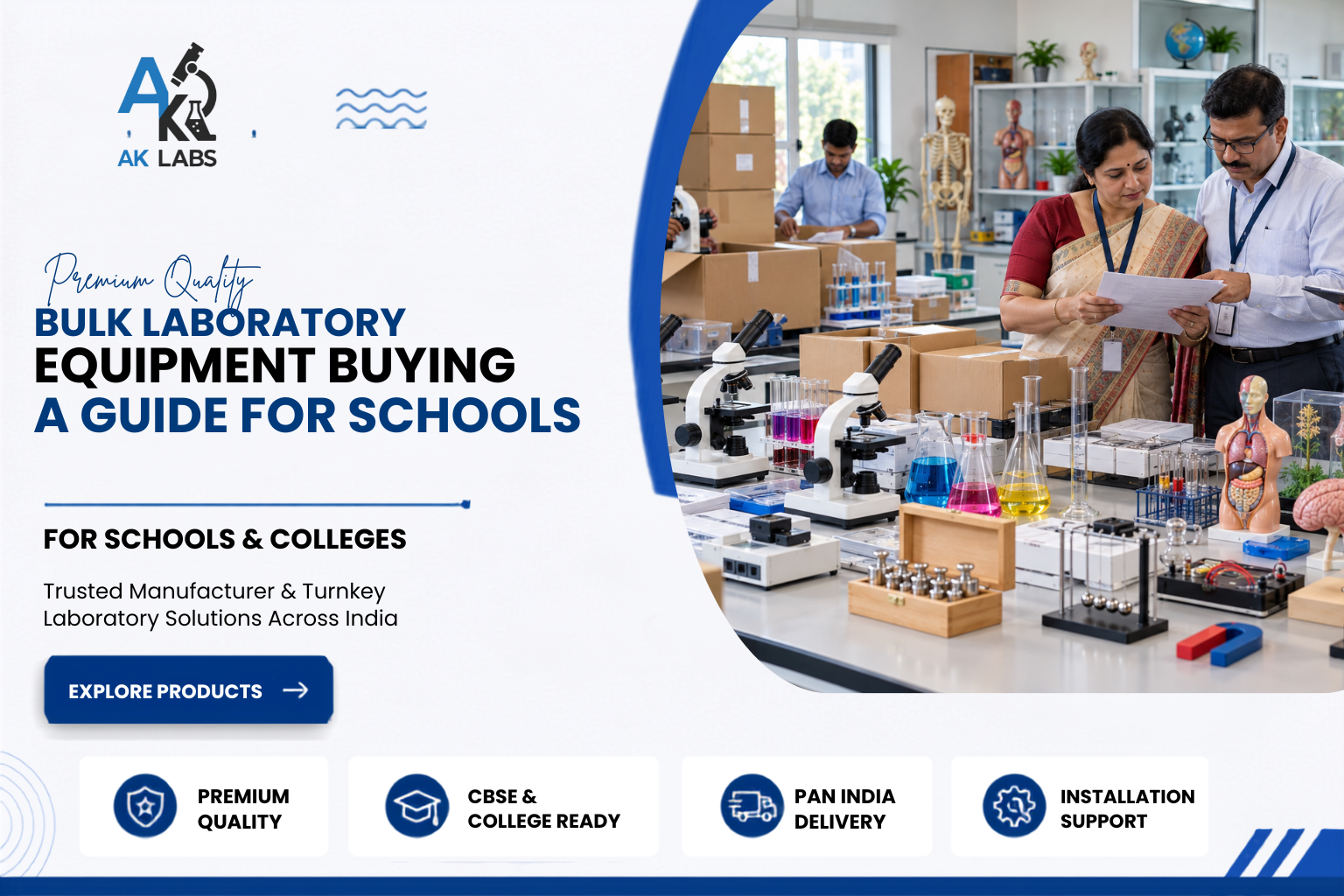
Planning to purchase laboratory equipment in bulk? Learn how schools can compare suppliers, prepare equipment lists, evaluate quality, manage budgets, and make smarter bulk laboratory purchases.
Setting up or upgrading a school laboratory often requires purchasing multiple types of equipment in large quantities. From Physics apparatus and Chemistry glassware to Biology models, microscopes, measuring instruments, STEM kits, and laboratory furniture, bulk purchasing can be a significant investment for educational institutions.
Buying laboratory equipment in bulk can simplify procurement and potentially provide better overall value. However, purchasing large quantities without proper planning can also lead to unnecessary expenses, unsuitable equipment, storage challenges, or delays.
A well-planned bulk purchase should consider educational requirements, product quality, specifications, quantity, supplier reliability, budget, warranty, delivery, and after-sales support.
Here is a practical guide to help schools plan their bulk laboratory equipment purchases.
1. Start With a Complete Laboratory Equipment List
Before contacting suppliers, schools should prepare a detailed list of the equipment they actually need.
The list can be divided according to laboratory or subject:
Physics Laboratory
- Ammeter
- Voltmeter
- Galvanometer
- Rheostat
- Vernier calipers
- Screw gauges
- Pendulum apparatus
- Optics equipment
- Magnetism apparatus
Chemistry Laboratory
- Beakers
- Test tubes
- Conical flasks
- Measuring cylinders
- Pipettes
- Burettes
- Funnels
- Tripod stands
- Chemistry models
Biology Laboratory
- Microscopes
- Microscope slides
- Specimens
- Biology models
- Dissection instruments
- Charts and educational models
STEM Laboratory
- Robotics kits
- Electronics kits
- Engineering models
- Renewable-energy models
- Coding and programming kits
- Hands-on STEM projects
Creating separate lists makes it easier to determine what is required, how much is required, and where each item will be used.
2. Determine the Quantity Required
Bulk purchasing does not simply mean buying as many products as possible.
Schools should calculate quantities according to:
- Number of students
- Number of laboratory sections
- Number of practical groups
- Number of teachers
- Frequency of experiments
- Existing inventory
- Expected future requirements
For example, if students conduct experiments in groups, the school may need multiple sets of the same apparatus rather than one set for the entire laboratory.
A proper quantity assessment helps prevent both shortages and unnecessary purchases.
3. Check Existing Laboratory Inventory
Before placing a bulk order, conduct an inventory of existing equipment.
Separate equipment into categories such as:
Good condition:
Ready for continued use.
Needs maintenance:
Can potentially be restored or serviced.
Damaged:
Requires repair or replacement.
Missing:
Previously purchased but currently unavailable.
This prevents schools from purchasing equipment they already have while ensuring that essential gaps are addressed.
4. Prepare a Realistic Budget
A laboratory budget should account for more than the product price.
Consider:
- Equipment cost
- Quantity
- Applicable taxes
- Delivery
- Installation
- Accessories
- Maintenance
- Calibration where applicable
- Replacement parts
- Warranty and service
Schools can divide the budget into categories such as Physics, Chemistry, Biology, STEM, safety equipment, and laboratory infrastructure.
This makes it easier to prioritize essential equipment if the available budget is limited.
5. Compare Product Specifications
When comparing bulk quotations, make sure the products are genuinely comparable.
Do not compare only the product names or prices.
Check:
- Material
- Dimensions
- Capacity
- Measurement range
- Accuracy
- Construction
- Included accessories
- Power requirements
- Compatibility
- Intended use
For example, two microscopes may have the same basic product name but significantly different specifications and capabilities.
Always compare like-for-like specifications before selecting the lowest quotation.
6. Evaluate Product Quality and Durability
School laboratory equipment can be used repeatedly by different groups of students.
Therefore, durability is particularly important for bulk purchases.
Schools should look at:
- Construction quality
- Material quality
- Finish
- Moving components
- Safety features
- Expected service life
- Suitability for repeated educational use
Choosing durable equipment can help schools avoid frequent replacement and unnecessary maintenance costs.
7. Choose the Right Supplier
The supplier plays an important role in a large laboratory purchase.
Before placing an order, schools should evaluate:
- Supplier experience
- Product range
- Manufacturing or sourcing capabilities
- Technical expertise
- Warranty
- After-sales support
- Delivery capacity
- Spare-parts availability
- Customer references
- Documentation
For a large order, the supplier should also be able to manage packing, transportation, coordination, and delivery efficiently.
8. Ask About Bulk Pricing
One of the potential advantages of bulk purchasing is access to volume-based pricing.
When requesting quotations, schools can ask whether the supplier provides:
- Quantity discounts
- Institutional pricing
- Complete laboratory packages
- Project-based pricing
- Special pricing for large orders
However, schools should not choose a supplier solely because it offers the biggest discount.
A lower price is useful only when the quality, specifications, warranty, and service meet the school's requirements.
9. Check Warranty and After-Sales Support
A bulk purchase may involve dozens or hundreds of individual products.
If problems occur after delivery, schools need a clear process for handling them.
Before approving the purchase, ask:
- What is the warranty period?
- What does the warranty cover?
- How are defective products reported?
- Is technical support available?
- Are spare parts available?
- Is installation provided where required?
- What is the repair or replacement process?
These details should be clearly understood before placing the order.
10. Plan Delivery and Installation
Large laboratory orders require proper logistics planning.
Schools should confirm:
- Expected delivery date
- Delivery location
- Packaging arrangements
- Number of shipments
- Installation requirements
- Unloading arrangements
- Inspection procedure after delivery
For complete laboratory projects, equipment may need to be delivered in coordination with laboratory furniture or other infrastructure.
Proper planning can help minimize delays.
11. Inspect Equipment After Delivery
Once the bulk order arrives, do not immediately distribute all equipment to different laboratories.
First, conduct a systematic inspection.
Check:
- Quantity received
- Product specifications
- Physical condition
- Accessories
- Packaging
- Model numbers
- Visible damage
- Missing components
Keep photographs and delivery records where appropriate.
If any item arrives damaged or incomplete, notify the supplier promptly according to the agreed process.
12. Maintain an Equipment Inventory
After receiving the equipment, create an inventory record.
A simple inventory can include:
| Equipment | Quantity | Department | Condition | Equipment ID |
|---|---|---|---|---|
| Microscope | 10 | Biology | New | BIO-001 |
| Digital Balance | 5 | Chemistry | New | CHEM-001 |
| Ammeter | 10 | Physics | New | PHY-001 |
| STEM Kit | 15 | STEM Lab | New | STEM-001 |
Equipment IDs can make future maintenance, inspection, and stock management easier.
Bulk Buying vs Individual Buying
| Factor | Bulk Purchase | Individual Purchase |
|---|---|---|
| Quantity | Large | Small |
| Pricing | May offer volume-based pricing | Usually standard pricing |
| Procurement | One coordinated purchase | Multiple purchases |
| Planning | Requires detailed preparation | Usually simpler |
| Delivery | May require logistical planning | Easier for small orders |
| Inventory | Requires organized storage | Easier to manage |
| Best For | New labs and major upgrades | Replacements and small requirements |
For schools setting up a new laboratory or conducting a major upgrade, bulk purchasing can be a practical approach when properly planned.
Common Mistakes Schools Should Avoid
Buying only on the basis of price
The cheapest quotation may not offer the best long-term value.
Not checking specifications
Products with similar names can have very different specifications.
Ordering without checking inventory
This can result in unnecessary duplicate purchases.
Ignoring warranty terms
Schools should understand what happens if equipment fails after delivery.
Not planning storage
Large quantities of equipment require appropriate storage space.
Ordering too late
Large institutional orders may require production and delivery time, so schools should plan procurement in advance.
Benefits of Buying Laboratory Equipment in Bulk
When properly planned, bulk purchasing can offer several advantages:
Better procurement planning
Schools can plan their complete laboratory requirements together.
Potential volume savings
Suppliers may offer quantity-based pricing for larger orders.
Standardized equipment
Purchasing multiple units of the same product can provide consistency across practical classes.
Simplified procurement
A coordinated purchase can reduce the need for repeated procurement processes.
Easier inventory management
A complete inventory can be established at the time of the laboratory upgrade.
Complete Bulk Laboratory Purchase Checklist
Before approving a large laboratory equipment order, schools should ask:
☑ Do we have a complete equipment list?
☑ Have we checked our existing inventory?
☑ Are quantities based on student requirements?
☑ Have we compared product specifications?
☑ Have we evaluated product quality?
☑ Have we compared multiple quotations?
☑ Are warranty terms clear?
☑ Is after-sales support available?
☑ Are delivery timelines confirmed?
☑ Are applicable taxes and other charges clear?
☑ Do we have adequate storage space?
☑ Is there a process for checking equipment after delivery?
Conclusion
Bulk laboratory equipment purchasing can be an efficient way for schools to set up new laboratories, upgrade existing facilities, and equip multiple departments.
However, successful procurement requires more than ordering products in large quantities.
Schools should begin with a detailed equipment list, assess their existing inventory, determine appropriate quantities, compare specifications and quality, evaluate suppliers, review warranties, and plan delivery and storage.
The goal should be to purchase the right equipment, in the right quantity, at the right value.
With careful planning, schools can create well-equipped laboratories that support practical learning and provide students with better opportunities to explore Science, Technology, Engineering, and Mathematics.
AK Labs provides scientific equipment, educational laboratory equipment, STEM learning models, and laboratory solutions for schools, colleges, and educational institutions.
Frequently Asked Questions (FAQs)
1. What is bulk laboratory equipment purchasing?
Bulk laboratory equipment purchasing involves buying multiple units or a large range of laboratory products through a single procurement process. It is commonly used when setting up or upgrading school and college laboratories.
2. Is buying laboratory equipment in bulk cheaper?
Bulk purchases may qualify for quantity-based or institutional pricing, but savings depend on the supplier, products, quantities, specifications, and other costs. Schools should compare the complete quotation rather than looking only at the discount.
3. What laboratory equipment can schools purchase in bulk?
Schools can purchase many types of equipment in bulk, including Physics apparatus, Chemistry glassware, Biology equipment, microscopes, measuring instruments, laboratory models, STEM kits, and laboratory accessories.
4. How do schools decide how much laboratory equipment to buy?
Quantities should be based on factors such as student numbers, practical groups, class levels, frequency of experiments, existing inventory, and future requirements.
5. What should schools check before approving a bulk laboratory order?
Schools should check product specifications, quality, quantity, pricing, applicable taxes, warranty, delivery, supplier reliability, after-sales support, and storage requirements.
6. How should schools compare bulk laboratory equipment quotations?
Compare quotations on a like-for-like basis. Check specifications, materials, quantities, accessories, warranty, taxes, delivery charges, installation, and service support—not just the final price.
7. Why is supplier experience important for bulk orders?
Large orders require reliable production, packaging, logistics, documentation, and after-sales support. An experienced supplier may be better equipped to coordinate these requirements.
8. What should schools do when bulk equipment arrives?
Schools should inspect the shipment for quantity, specifications, physical damage, missing accessories, and other discrepancies before distributing the equipment for use.
9. Can schools request customized laboratory equipment?
Some manufacturers can provide customized equipment or laboratory solutions depending on the product and project requirements. Schools should discuss specifications with the supplier before placing the order.
10. Should schools buy all laboratory equipment from one supplier?
Not necessarily. A single supplier can simplify procurement and coordination, but schools should select suppliers based on product suitability, quality, pricing, technical support, and overall value.