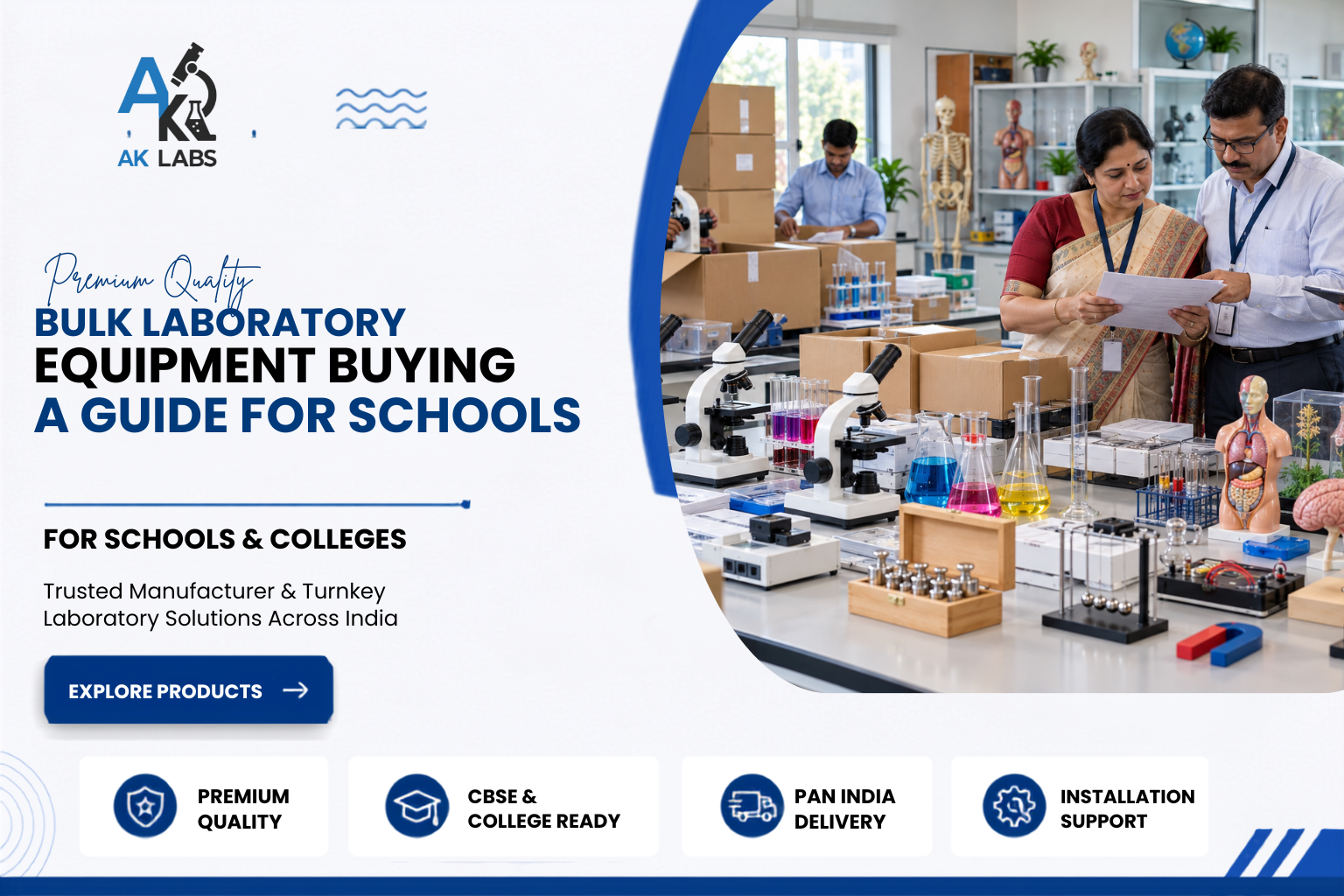
Learn how to calculate the total cost of setting up a school science laboratory, including equipment, furniture, safety systems, installation, consumables, and maintenance.
Setting up a science laboratory is a significant investment for any school. Whether you are creating a new Physics, Chemistry, Biology, or STEM laboratory or upgrading an existing facility, calculating the total project cost before purchasing equipment is essential.
Many schools make the mistake of calculating their budget based only on the cost of laboratory equipment. However, a complete science lab may also require laboratory furniture, electrical work, plumbing, safety equipment, installation, consumables, storage, and maintenance.
A proper budget should therefore consider the complete laboratory setup rather than individual products alone.
In this guide, we explain how schools can calculate the total cost of setting up a science laboratory.
1. Start With the Laboratory Requirements
The first step is to determine exactly what type of laboratory you are planning.
For example:
- Physics Laboratory
- Chemistry Laboratory
- Biology Laboratory
- General Science Laboratory
- STEM Laboratory
- Composite Science Laboratory
The requirements will vary depending on the subject, student age group, curriculum, number of students, and experiments conducted.
A laboratory for 20 students will have different equipment requirements from one designed for 50 or 60 students.
Ask these questions first:
- How many students will use the lab?
- Which classes will use it?
- Which subjects will be taught?
- How many students will work in one group?
- What experiments are required?
- Is the laboratory new or being upgraded?
- What equipment is already available?
These answers provide the foundation for your budget.
2. Calculate the Cost of Laboratory Equipment
Laboratory equipment is usually one of the largest components of the budget.
Create separate equipment lists for each subject.
Physics Equipment
Examples include:
- Ammeter
- Voltmeter
- Galvanometer
- Rheostat
- Vernier caliper
- Screw gauge
- Optics apparatus
- Magnetism apparatus
- Pendulum apparatus
- Electrical experiment kits
Chemistry Equipment
Examples include:
- Beakers
- Test tubes
- Conical flasks
- Measuring cylinders
- Pipettes
- Burettes
- Funnels
- Tripod stands
- Crucibles
- Laboratory balances
Biology Equipment
Examples include:
- Microscopes
- Microscope slides
- Specimens
- Biology models
- Dissection instruments
- Charts
- Prepared slides
STEM Equipment
Examples include:
- Robotics kits
- Electronics kits
- Coding kits
- Engineering models
- Renewable-energy models
- STEM project kits
Calculate:
Equipment Cost = Quantity × Unit Price
Then add the cost of all equipment categories.
3. Include Laboratory Furniture
Furniture is another major component of a laboratory setup.
Depending on the laboratory, you may require:
- Student laboratory tables
- Work benches
- Teacher demonstration tables
- Laboratory stools
- Storage cabinets
- Chemical storage cabinets
- Sink units
- Wall-mounted storage
- Display boards
- Equipment racks
Furniture requirements depend on the available room size and laboratory layout.
When requesting a quotation, ask whether furniture includes delivery, installation, fittings, and accessories, where applicable.
4. Calculate Electrical and Plumbing Requirements
Some laboratories require additional infrastructure before equipment can be installed.
Possible costs include:
Electrical Work
- Power sockets
- Wiring
- Distribution boards
- Lighting
- Circuit protection
- Earthing
- Additional electrical points
Plumbing
- Laboratory sinks
- Water supply
- Drainage
- Faucets
- Wastewater arrangements
The exact requirements depend on the laboratory design and existing school infrastructure.
5. Add Laboratory Safety Equipment
Safety equipment should be included in the initial budget rather than treated as an afterthought.
Depending on the laboratory, schools may need:
- Fire extinguishers
- First-aid equipment
- Safety goggles
- Protective gloves
- Lab coats
- Emergency signage
- Spill-control materials
- Appropriate ventilation systems
- Safety storage
Chemistry laboratories may require additional safety infrastructure depending on the chemicals and experiments involved.
6. Include Installation and Setup Costs
Some laboratory equipment may require installation, assembly, demonstration, or configuration.
Examples include:
- Microscopes and specialized instruments
- Laboratory furniture
- Electrical equipment
- STEM and robotics systems
- Specialized scientific instruments
- Complete laboratory setups
Ask the supplier whether installation is included in the quoted price or charged separately.
7. Budget for Initial Consumables
Consumables are materials that are used during experiments and need to be replaced regularly.
Examples include:
- Chemicals
- Filter paper
- Microscope slides
- Cover slips
- Gloves
- Cleaning materials
- Batteries
- Wires
- Electrodes
- Other experiment-specific materials
The initial consumables budget should be separated from the cost of durable equipment.
8. Consider Delivery and Logistics
For large laboratory projects, transportation can be an important part of the overall cost.
Ask suppliers about:
- Delivery charges
- Packaging
- Insurance, where applicable
- Unloading requirements
- Installation
- Delivery timeline
For bulk orders, schools should clarify all applicable delivery and logistics charges before approving the purchase.
9. Include Calibration and Maintenance
Some measuring and scientific instruments require periodic inspection, servicing, or calibration.
Examples may include:
- Digital balances
- pH meters
- Thermometers
- Precision measuring instruments
- Specialized scientific equipment
Schools should consider both initial setup costs and recurring maintenance costs when planning the laboratory budget.
10. Calculate the Total Project Cost
Once every category has been identified, create a complete budget.
A simple formula is:
Total Science Lab Cost =
Laboratory Equipment
- Furniture
- Electrical Work
- Plumbing
- Safety Equipment
- Installation
- Initial Consumables
- Delivery & Logistics
- Other Applicable Costs
For example, a school might organize its budget like this:
| Cost Category | Estimated Cost |
|---|---|
| Laboratory Equipment | ₹4,00,000 |
| Laboratory Furniture | ₹2,00,000 |
| Electrical & Plumbing | ₹75,000 |
| Safety Equipment | ₹30,000 |
| Installation | ₹40,000 |
| Initial Consumables | ₹35,000 |
| Delivery & Logistics | ₹20,000 |
| Estimated Total | ₹8,00,000 |
Note: These figures are only an example of how to structure a budget. Actual costs will vary significantly based on laboratory size, specifications, quantity, infrastructure, supplier, and location.
11. Don't Forget GST and Other Applicable Charges
When comparing quotations, schools should check whether prices are:
- Inclusive of GST
- Exclusive of GST
- Inclusive of delivery
- Inclusive of installation
- Inclusive of accessories
A quotation with a lower base price may not necessarily have the lowest final payable amount.
Always compare the final landed/project cost.
12. Keep a Contingency Budget
Unexpected expenses can occur during a laboratory project.
For example:
- Additional electrical work
- Replacement of damaged infrastructure
- Additional equipment
- Installation requirements
- Changes to the laboratory layout
- Unforeseen repair work
Schools can consider keeping a reasonable contingency amount within their overall project budget.
The exact amount should depend on the project's complexity and the school's procurement policies.
New Science Lab vs Existing Lab Upgrade
The total cost can vary considerably depending on whether you are starting from scratch or upgrading an existing laboratory.
| Requirement | New Laboratory | Existing Lab Upgrade |
|---|---|---|
| Equipment | High | Depends on existing inventory |
| Furniture | Often required | May be partially reusable |
| Electrical Work | May be extensive | May require limited upgrades |
| Plumbing | May be required | Existing infrastructure may be usable |
| Safety Equipment | Required | May need replacement/additions |
| Installation | Potentially higher | Usually more limited |
| Budget | Generally higher | Often lower |
Before buying new equipment, schools should conduct an existing inventory assessment. Equipment that is still safe and functional may not need replacement.
How to Reduce Science Lab Setup Costs
A limited budget does not necessarily mean compromising on the quality of the laboratory.
Schools can consider:
1. Prioritize essential equipment
Purchase equipment needed for core practical activities first.
2. Buy in bulk
Larger institutional orders may qualify for quantity-based pricing, depending on the supplier.
3. Compare multiple quotations
Compare specifications, warranty, service, delivery, and total cost—not just the discount.
4. Reuse suitable existing equipment
Functional equipment can remain part of the new laboratory where appropriate.
5. Choose durable products
Equipment that can withstand regular student use may provide better long-term value.
6. Plan the laboratory layout first
A proper layout can help prevent unnecessary purchases and reduce installation changes later.
Questions to Ask Your Laboratory Equipment Supplier
Before approving a science laboratory project, ask the supplier:
- Is the quotation based on the exact required specifications?
- Are accessories included?
- Is GST included?
- Are delivery charges included?
- Is installation included?
- What is the warranty period?
- Is after-sales support available?
- Are spare parts available?
- Can equipment be customized?
- Can the supplier provide a complete laboratory setup?
Getting clear answers before placing the order can help schools avoid unexpected expenses.
Complete Science Lab Budget Checklist
Before finalizing your budget, make sure you have considered:
☑ Laboratory equipment
☑ Physics equipment
☑ Chemistry equipment
☑ Biology equipment
☑ STEM equipment
☑ Laboratory furniture
☑ Storage
☑ Electrical work
☑ Plumbing
☑ Safety equipment
☑ Installation
☑ Initial consumables
☑ Delivery and logistics
☑ GST and applicable taxes
☑ Calibration and maintenance
☑ Contingency budget
Conclusion
Calculating the cost of setting up a science laboratory requires more than adding up the prices of microscopes, beakers, Physics apparatus, or other equipment.
A complete budget should consider equipment, furniture, infrastructure, safety, installation, consumables, delivery, taxes, and long-term maintenance.
Schools should begin by assessing their requirements and existing inventory, then create a detailed equipment list and compare quotations based on specifications and total project cost.
With proper planning, schools can create a safe, functional, well-equipped science laboratory while making the best use of their available budget.
AK Labs provides scientific equipment, educational laboratory equipment, STEM learning models, and laboratory solutions for schools, colleges, and educational institutions.
Frequently Asked Questions (FAQs)
1. How much does it cost to set up a science lab in a school?
There is no single fixed cost. The total depends on the laboratory type, room size, number of students, equipment specifications, furniture, infrastructure, safety requirements, and other project requirements.
2. What is included in the cost of setting up a science laboratory?
A complete laboratory budget may include equipment, furniture, electrical and plumbing work, safety equipment, installation, initial consumables, delivery, taxes, and other applicable costs.
3. What is the biggest expense when setting up a school science lab?
Laboratory equipment and furniture are often major cost categories, but the exact proportion varies depending on the type and scope of the laboratory project.
4. How can schools reduce the cost of setting up a science lab?
Schools can prioritize essential equipment, compare quotations, purchase suitable products in bulk, reuse functional existing equipment, and choose durable products that provide good long-term value.
5. Should schools include GST when calculating the laboratory budget?
Yes. Schools should determine whether quoted prices include or exclude GST and other applicable charges and calculate the final payable project cost accordingly.
6. Is laboratory furniture included with laboratory equipment?
Not necessarily. Furniture may be quoted separately or included as part of a complete laboratory solution. Schools should confirm this with the supplier.
7. Does a new laboratory require electrical and plumbing work?
It depends on the existing infrastructure and laboratory requirements. Chemistry laboratories and certain specialized setups may require specific plumbing, drainage, electrical, or ventilation arrangements.
8. How much equipment does a school science lab need?
The required quantity depends on the number of students, practical groups, class levels, experiments, and curriculum requirements. Schools should calculate quantities based on actual usage rather than purchasing arbitrary numbers.
9. Should schools budget for laboratory maintenance?
Yes. Schools should consider recurring costs such as servicing, calibration where required, replacement parts, and consumables when planning the long-term laboratory budget.
10. Can a laboratory equipment supplier provide a complete lab setup?
Some suppliers provide complete or turnkey laboratory solutions, including equipment, furniture, installation, and other components. Schools should confirm exactly what is included in the proposed package.