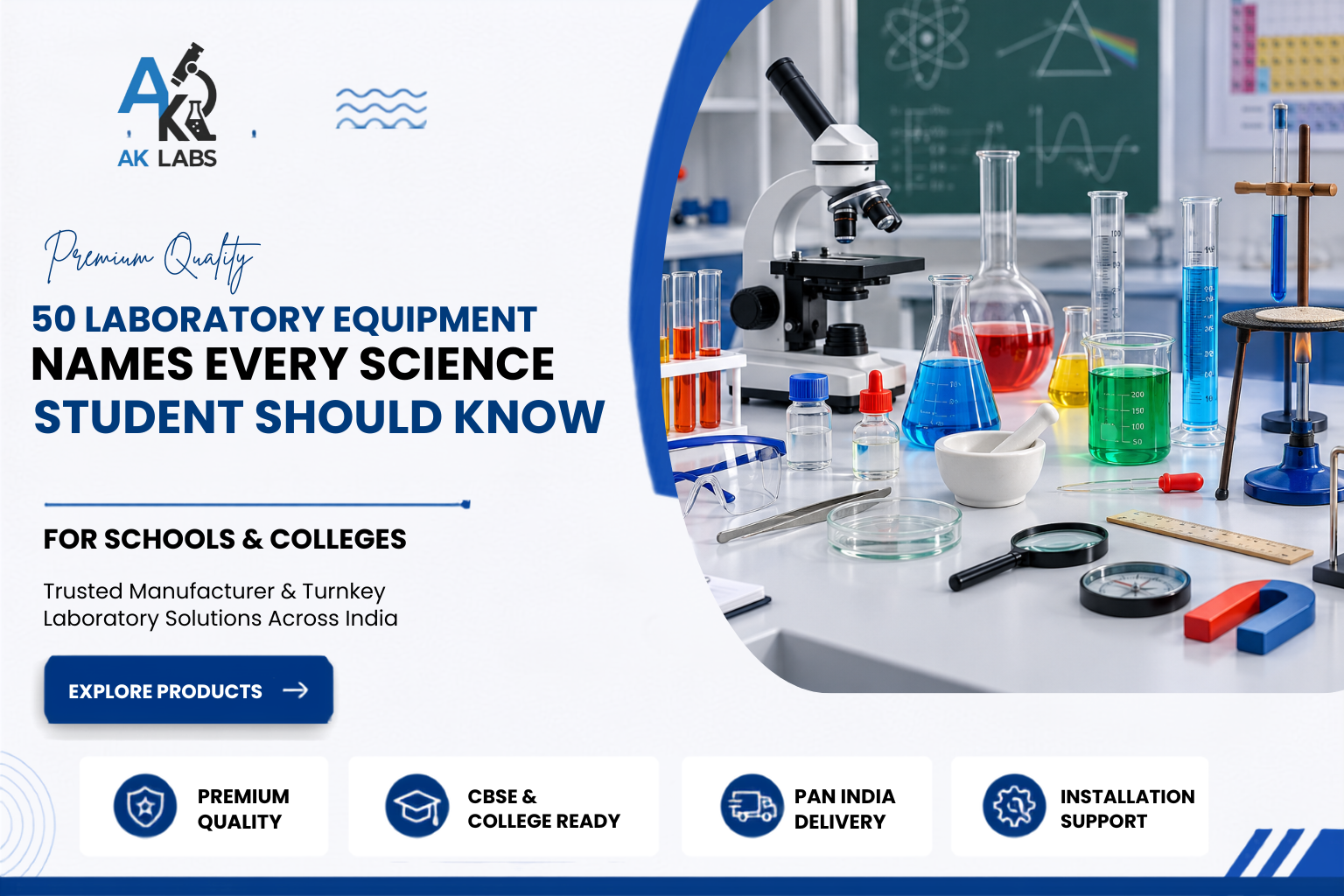
Learn about 50 essential laboratory equipment names, their uses, and importance in school and college science laboratories. A simple guide for students, teachers, and science enthusiasts.
A science laboratory is where classroom theories turn into practical knowledge. Whether you are studying Physics, Chemistry, Biology, or general science, knowing the names and uses of laboratory equipment is an essential part of practical learning.
From simple glassware such as beakers and test tubes to precision instruments such as microscopes and balances, every piece of laboratory equipment has a specific purpose.
In this guide, we have listed 50 commonly used laboratory equipment names and their uses to help students become more familiar with the tools they may encounter in a science laboratory.
1. Beaker
A beaker is a cylindrical container used for holding, mixing, heating, and transferring liquids. It is one of the most commonly used pieces of laboratory glassware.
2. Test Tube
Test tubes are small glass or plastic tubes used for holding, mixing, and heating small quantities of substances during experiments.
3. Test Tube Stand
A test tube stand holds test tubes upright and keeps them organized during experiments.
4. Conical Flask
Also called an Erlenmeyer flask, a conical flask is used for mixing, heating, and storing liquids. Its narrow neck helps reduce the risk of spilling.
5. Volumetric Flask
A volumetric flask is designed to prepare solutions with a highly accurate and specific volume.
6. Measuring Cylinder
A measuring cylinder is used to measure liquid volumes more accurately than a beaker.
7. Pipette
A pipette is used to transfer a measured quantity of liquid from one container to another.
8. Burette
A burette is a graduated tube with a control valve that is commonly used to deliver precise volumes of liquids during titration experiments.
9. Funnel
A laboratory funnel helps transfer liquids or fine materials into containers with narrow openings.
10. Filter Paper
Filter paper is used to separate solid particles from liquids during filtration.
11. Watch Glass
A watch glass is a shallow glass dish used for evaporating liquids, covering beakers, or holding small samples.
12. Glass Rod
A glass rod is commonly used for stirring solutions and assisting in the transfer of liquids.
13. Spatula
A laboratory spatula is used to scoop, transfer, and handle small quantities of solid chemicals.
14. Dropper
A dropper transfers small quantities of liquid, usually one drop at a time.
15. Mortar and Pestle
Mortar and pestle are used to crush and grind solid substances into smaller particles or powders.
16. Thermometer
A laboratory thermometer measures the temperature of substances during experiments.
17. Laboratory Balance
A laboratory balance is used to measure the mass of chemicals and other materials accurately.
18. Tripod Stand
A tripod stand supports laboratory vessels such as beakers and flasks while they are being heated.
19. Wire Gauze
Wire gauze is placed on a tripod stand to support containers and distribute heat more evenly.
20. Bunsen Burner
A Bunsen burner provides a controlled flame for heating substances in laboratory experiments.
21. Spirit Lamp
A spirit lamp is a small heating device that uses alcohol or another suitable fuel to produce a flame.
22. Test Tube Holder
A test tube holder allows students to safely hold test tubes, particularly when they are being heated.
23. Crucible
A crucible is a heat-resistant container used for heating substances to very high temperatures.
24. Crucible Tongs
Crucible tongs are designed to safely handle hot crucibles and other small heated laboratory objects.
25. Evaporating Dish
An evaporating dish is used to heat solutions and evaporate solvents to obtain solid substances.
26. Wash Bottle
A wash bottle is used to dispense distilled or purified water for cleaning glassware and rinsing laboratory equipment.
27. Reagent Bottle
Reagent bottles are specially designed containers used for storing chemicals and laboratory solutions.
28. Separating Funnel
A separating funnel is used to separate two immiscible liquids based on their different densities.
29. Distillation Flask
A distillation flask is used to heat liquids during the distillation process.
30. Condenser
A condenser cools vapor and converts it back into liquid during distillation and other experiments.
31. Microscope
A microscope magnifies extremely small objects and specimens, making it an essential instrument for Biology and other life-science studies.
32. Microscope Slides
Microscope slides are thin pieces of glass used to hold specimens for observation under a microscope.
33. Cover Slip
A cover slip is a thin piece of glass placed over a specimen on a microscope slide.
34. Forceps
Forceps are used to hold and transfer small objects or specimens without directly touching them.
35. Dissection Tray
A dissection tray provides a suitable surface for performing biological dissections and studying specimens.
36. Dissection Instruments
Dissection instruments such as scissors, scalpels, probes, and forceps are used during Biology practical activities.
37. Vernier Caliper
A Vernier caliper is a precision measuring instrument used to measure length, diameter, and depth accurately.
38. Screw Gauge
A screw gauge is used to measure very small dimensions, such as the diameter of thin wires or the thickness of small objects.
39. Meter Scale
A meter scale is a basic measuring instrument used to measure length and distance in Physics experiments.
40. Ammeter
An ammeter measures electric current in an electrical circuit.
41. Voltmeter
A voltmeter measures the potential difference or voltage between two points in an electrical circuit.
42. Galvanometer
A galvanometer is a sensitive instrument used to detect and measure small electric currents.
43. Rheostat
A rheostat is a variable resistor used to control the amount of current flowing through an electrical circuit.
44. Compass
A laboratory compass can be used to demonstrate magnetic fields and determine the direction of magnetic forces in Physics experiments.
45. Bar Magnet
A bar magnet is commonly used in Physics experiments to demonstrate magnetic fields, attraction, and repulsion.
46. Pendulum Apparatus
A pendulum apparatus helps students study concepts such as time period, oscillation, and acceleration due to gravity.
47. Calorimeter
A calorimeter is used to study heat transfer and measure the heat involved in physical or chemical processes.
48. Spring Balance
A spring balance measures force or weight and is commonly used in school Physics experiments.
49. pH Meter
A pH meter is an electronic instrument used to measure the acidity or alkalinity of a solution.
50. Centrifuge
A centrifuge separates components of a mixture by spinning samples at high speed. It is commonly used in Biology, Chemistry, and medical laboratories.
Why Is It Important for Students to Know Laboratory Equipment?
Understanding laboratory equipment is more than simply memorizing names. Students should also understand what each instrument does and how it is used safely.
Knowing laboratory equipment helps students:
- Perform practical experiments more confidently
- Select the correct equipment for an experiment
- Improve accuracy in measurements
- Understand scientific procedures
- Follow laboratory safety practices
- Develop hands-on scientific skills
Practical knowledge also helps students connect theoretical concepts with real-world applications.
Laboratory Equipment and Practical Science Learning
A well-equipped laboratory provides students with opportunities to observe, measure, experiment, and draw conclusions based on their own observations.
For example, students can use a microscope to observe biological specimens, a voltmeter and ammeter to study electrical circuits, or a burette and pipette to perform accurate chemical experiments.
This hands-on approach can make science more engaging and easier to understand.
Choose the Right Laboratory Equipment
Schools and educational institutions should select laboratory equipment based on factors such as quality, accuracy, durability, safety, curriculum requirements, and student age group.
A properly planned laboratory should include the essential equipment required for Physics, Chemistry, Biology, and other practical activities.
AK Labs provides scientific and educational laboratory equipment designed for schools, colleges, educational institutions, and science learning environments.
Conclusion
Laboratory equipment plays an important role in practical science education. From basic tools like test tubes and beakers to advanced instruments like microscopes, pH meters, and centrifuges, each piece of equipment helps students explore scientific concepts through practical experience.
Learning the names, functions, and correct uses of laboratory equipment is an important first step toward becoming confident in the science laboratory.