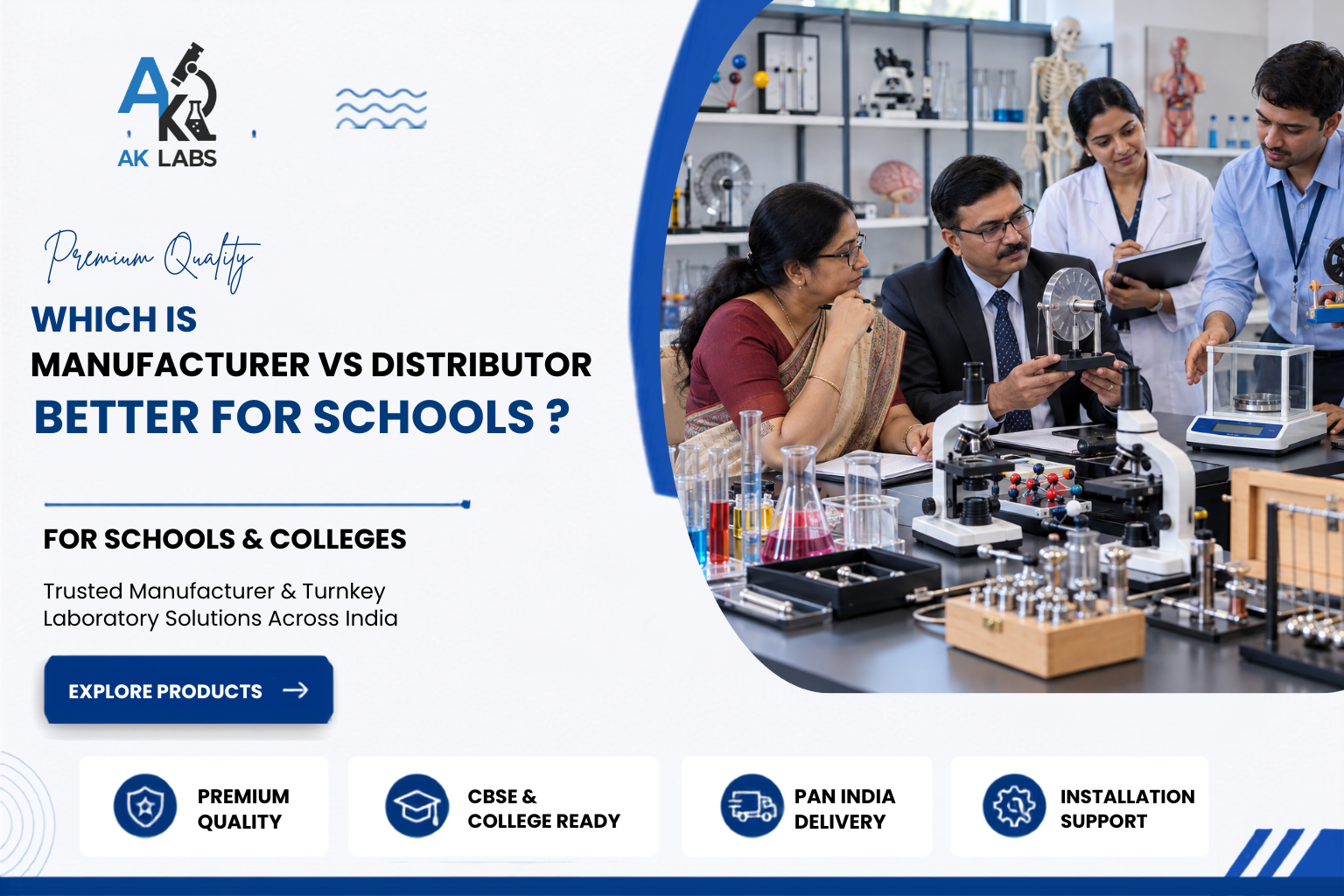
Choosing between a laboratory equipment manufacturer and distributor can affect price, customization, quality, support, and delivery. Learn which option may be better for your school's laboratory requirements.
When schools plan to set up a new science laboratory or upgrade an existing one, choosing the right laboratory equipment supplier is an important decision.
Schools may purchase equipment directly from a manufacturer or source products through a distributor. Both options can have advantages depending on the type of equipment required, budget, quantity, delivery requirements, and level of technical support needed.
So, which is better for schools — a manufacturer or a distributor?
The answer depends on the school's specific requirements.
Let's understand the difference.
What Is a Laboratory Equipment Manufacturer?
A manufacturer is a company that designs, develops, produces, assembles, or manufactures laboratory equipment.
A manufacturer may offer products such as:
- Physics laboratory apparatus
- Chemistry laboratory equipment
- Biology equipment and models
- Scientific instruments
- STEM learning models
- Educational kits
- Laboratory furniture
- Customized laboratory solutions
Because manufacturers are involved directly in production, they may have greater control over product specifications, manufacturing quality, and customization.
What Is a Laboratory Equipment Distributor?
A distributor purchases products from manufacturers or other suppliers and supplies them to schools, colleges, laboratories, and other customers.
Distributors may offer equipment from multiple brands or manufacturers, giving customers access to a broader range of products through one supplier.
This can be useful when a school needs different types of equipment from several manufacturers.
Manufacturer vs Distributor: Key Differences
| Factor | Manufacturer | Distributor |
|---|---|---|
| Product Source | Produces or assembles products | Sources products from manufacturers |
| Product Range | Usually focused on its own products | Can offer products from multiple brands |
| Customization | Often more flexible | Usually depends on manufacturer |
| Pricing | May offer direct pricing | May include distribution margins |
| Technical Knowledge | Direct product expertise | Depends on distributor's expertise |
| Bulk Orders | Often suitable for large projects | Can also handle bulk orders |
| Multiple Brands | Generally limited to own range | Often offers multiple brands |
| After-Sales Support | May provide direct support | Support depends on distributor/manufacturer |
| Lab Turnkey Solutions | May provide integrated solutions | May coordinate products from different sources |
1. Pricing and Overall Value
Price is naturally an important consideration for schools working with a fixed laboratory budget.
Buying directly from a manufacturer can sometimes provide competitive pricing, particularly for bulk purchases or large laboratory projects.
However, distributors may also offer competitive packages because they work with multiple manufacturers and can source different products together.
Schools should therefore compare complete quotations rather than assuming one purchasing channel is always cheaper.
Consider:
- Product price
- Quantity discounts
- Taxes
- Delivery charges
- Installation
- Warranty
- Accessories
- Maintenance
- After-sales service
The lowest quotation is not necessarily the best overall value.
2. Product Range
One of the biggest differences is product variety.
A manufacturer generally specializes in its own product range, while a distributor may supply equipment from multiple manufacturers.
For example, a school requiring:
- Physics apparatus
- Chemistry glassware
- Biology models
- Microscopes
- STEM kits
- Laboratory furniture
may find a distributor convenient if all these products can be sourced through one supplier.
On the other hand, if the school wants a consistent product range from one manufacturer, purchasing directly may be preferable.
3. Customization
Customization can be an important factor when setting up a school laboratory.
Schools may have specific requirements related to:
- Equipment specifications
- Quantities
- Lab layouts
- Educational models
- Demonstration systems
- Laboratory furniture
- STEM setups
- Complete laboratory packages
Manufacturers may be better positioned to discuss customization because they have direct involvement in product design and production.
A distributor may also arrange customized solutions, but this often depends on the capabilities of the manufacturer they represent.
4. Technical Expertise
When purchasing scientific equipment, product knowledge matters.
A manufacturer generally has direct knowledge of its own products, including:
- Specifications
- Operating procedures
- Maintenance requirements
- Replacement components
- Product limitations
- Technical features
A knowledgeable distributor can also provide strong technical support, particularly if they specialize in laboratory equipment.
Before purchasing, schools should ask whether the supplier can provide product demonstrations, technical guidance, installation assistance, and after-sales support where required.
5. Warranty and After-Sales Support
Laboratory equipment is a long-term investment, so support after the sale should not be overlooked.
Before approving a purchase, schools should understand:
- Warranty period
- Warranty coverage
- Service process
- Availability of spare parts
- Repair support
- Calibration requirements
- Installation support
- Expected service response
Whether buying from a manufacturer or distributor, schools should obtain these details in writing wherever appropriate.
6. Bulk and Institutional Purchases
Schools and educational institutions often purchase laboratory equipment in larger quantities.
For large projects, a manufacturer can potentially offer:
- Bulk pricing
- Standardized equipment
- Customized products
- Direct technical coordination
- Project-based support
However, established distributors can also manage large institutional orders and coordinate equipment from several brands.
The right choice depends on the scope and complexity of the project.
When Should a School Choose a Manufacturer?
Buying directly from a manufacturer may be particularly suitable when a school:
Needs large quantities
For example, a complete Physics, Chemistry, or Biology laboratory setup.
Wants customized equipment
The school may have specific product or project requirements.
Wants standardized equipment
Purchasing from one manufacturer can help maintain consistency across a laboratory.
Requires direct technical support
Direct access to the manufacturer can simplify product-specific support.
Is planning a complete lab project
Manufacturers offering laboratory solutions may be able to coordinate equipment and setup requirements.
When Should a School Choose a Distributor?
A distributor may be a good option when a school:
Needs products from multiple brands
A distributor can potentially consolidate products from different manufacturers into one purchase.
Needs a wide product range
Distributors can be useful when a school requires different categories of equipment.
Wants convenient sourcing
Instead of contacting several manufacturers, schools may be able to purchase multiple products through one supplier.
Needs smaller quantities
For certain requirements, distributors may be convenient for sourcing individual products or smaller orders.
What Should Schools Check Before Choosing?
Instead of asking only "Manufacturer or distributor?", schools should ask:
1. Does the supplier understand educational laboratories?
A supplier should understand the requirements of schools, teachers, and students.
2. Are product specifications clearly provided?
Every quotation should clearly identify the equipment, specifications, quantity, and applicable terms.
3. Is after-sales support available?
Ask about warranty, repairs, spare parts, installation, and technical assistance.
4. Can the supplier handle bulk orders?
For complete laboratory projects, delivery and coordination capabilities are important.
5. Can they provide documentation?
Schools may require quotations, invoices, product specifications, warranty information, and other relevant documents.
6. Is the pricing transparent?
Compare quotations on a like-for-like basis, including accessories, taxes, delivery, installation, and other applicable costs.
Manufacturer vs Distributor: Which One Should You Choose?
There is no universal answer.
A manufacturer may be the better choice when a school needs direct product expertise, customization, standardized equipment, or a large laboratory project.
A distributor may be more convenient when a school needs products from multiple manufacturers, a broad product range, or consolidated sourcing.
The most important factor is not simply whether the supplier is a manufacturer or distributor. Schools should evaluate the supplier's product quality, technical knowledge, reliability, pricing, warranty, service, and ability to meet the school's specific requirements.
Why Direct Manufacturer Support Can Be Valuable
For complex laboratory projects, working directly with a manufacturer can simplify communication between the school and the company responsible for producing the equipment.
This can be particularly useful for:
- Customized laboratory equipment
- Large institutional orders
- STEM laboratory setups
- Complete laboratory solutions
- Product demonstrations
- Technical specifications
- Long-term service requirements
However, a distributor with strong technical expertise and reliable manufacturer relationships can also provide valuable support.
Conclusion
Choosing between a laboratory equipment manufacturer and distributor depends on the school's needs.
For a large, customized, or complete laboratory setup, a manufacturer may provide advantages such as direct product expertise and greater control over customization.
For schools that need multiple brands or a wide variety of products, a distributor may offer greater convenience.
Before making a final decision, schools should compare suppliers based on quality, specifications, pricing, warranty, after-sales support, delivery, technical expertise, and long-term value.
A carefully selected supplier can help schools build a laboratory that supports practical learning and serves students effectively for years.
AK Labs provides scientific equipment, educational laboratory equipment, STEM learning models, and laboratory solutions for schools, colleges, and educational institutions.
Frequently Asked Questions (FAQs)
1. Is it better to buy laboratory equipment directly from a manufacturer?
Buying directly from a manufacturer can be beneficial for large orders, customized equipment, standardized products, and projects requiring direct technical support. However, the best option depends on the school's specific requirements.
2. What is the main difference between a manufacturer and a distributor?
A manufacturer produces or assembles the equipment, while a distributor generally sources and supplies equipment from manufacturers to customers.
3. Are laboratory equipment manufacturers cheaper than distributors?
Not always. Pricing depends on product specifications, quantity, discounts, delivery, services, and other factors. Schools should compare complete quotations rather than assuming one option will always be cheaper.
4. Can distributors provide equipment from multiple manufacturers?
Yes. One advantage of a distributor can be the ability to source products from multiple manufacturers or brands, depending on its supplier network.
5. Who provides better after-sales service — manufacturer or distributor?
It depends on the supplier. Schools should check warranty terms, service arrangements, technical support, spare-parts availability, and response procedures before purchasing.
6. Which is better for a complete school laboratory setup?
For a complete laboratory project, a manufacturer offering integrated laboratory solutions may be advantageous. However, an experienced distributor can also coordinate equipment from multiple suppliers. Schools should compare capabilities and project support.
7. Can laboratory equipment be customized?
Yes, certain laboratory equipment and educational models can be customized depending on the manufacturer, product type, specifications, and project requirements.
8. What should schools ask a laboratory equipment supplier before buying?
Schools should ask about product specifications, quality, warranty, delivery time, installation, technical support, spare parts, maintenance, certifications or compliance documentation where applicable, and total cost.
9. Should schools compare multiple laboratory equipment suppliers?
Yes. Comparing multiple suppliers can help schools evaluate differences in specifications, quality, pricing, warranty, service, and delivery before making a purchasing decision.
10. What is more important than choosing a manufacturer or distributor?
The supplier's quality, reliability, technical expertise, product suitability, service support, transparency, and overall value are more important than the supplier category alone.