Explore how Kendriya Vidyalayas can strengthen practical and experiential learning through well-equipped science laboratories, educational kits, STEM activities, mathematics learning, astronomy, robotics, and hands-on projects that encourage students to learn by doing.
Education becomes more meaningful when students have opportunities to explore concepts beyond textbooks. Practical activities, experiments, educational models, science kits, mathematics activities, and STEM projects allow students to understand concepts by observing, creating, testing, and solving problems.
For schools such as Kendriya Vidyalayas, where students come from diverse backgrounds and may have different learning interests, hands-on learning can provide an engaging way to connect classroom concepts with real-world applications.
A well-planned practical learning environment can include science laboratories, activity-based learning resources, STEM projects, mathematics kits, astronomy activities, robotics, and educational models.
Why Is Practical Learning Important?
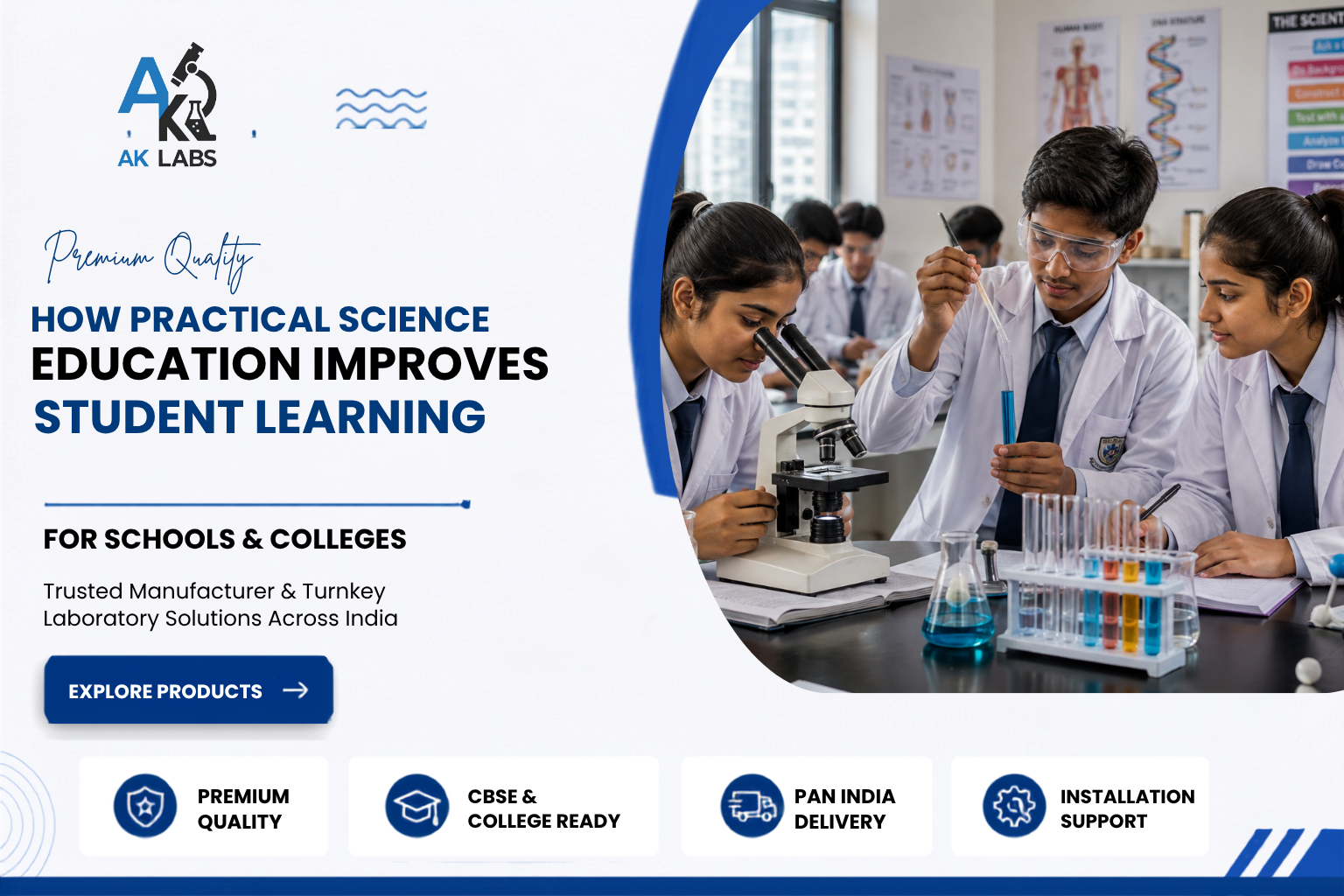
Traditional classroom teaching provides students with important theoretical knowledge, but practical activities give them an opportunity to apply that knowledge.
For example, students can understand:
- Physics through experiments
- Chemistry through reactions and observations
- Biology through models, specimens, and microscopy
- Mathematics through activity-based learning
- Geography through models and demonstrations
- Astronomy through observation and models
- Technology through robotics and STEM projects
This approach encourages students to ask questions and explore possible solutions instead of simply memorizing information.
1. Make Science Learning More Experiential
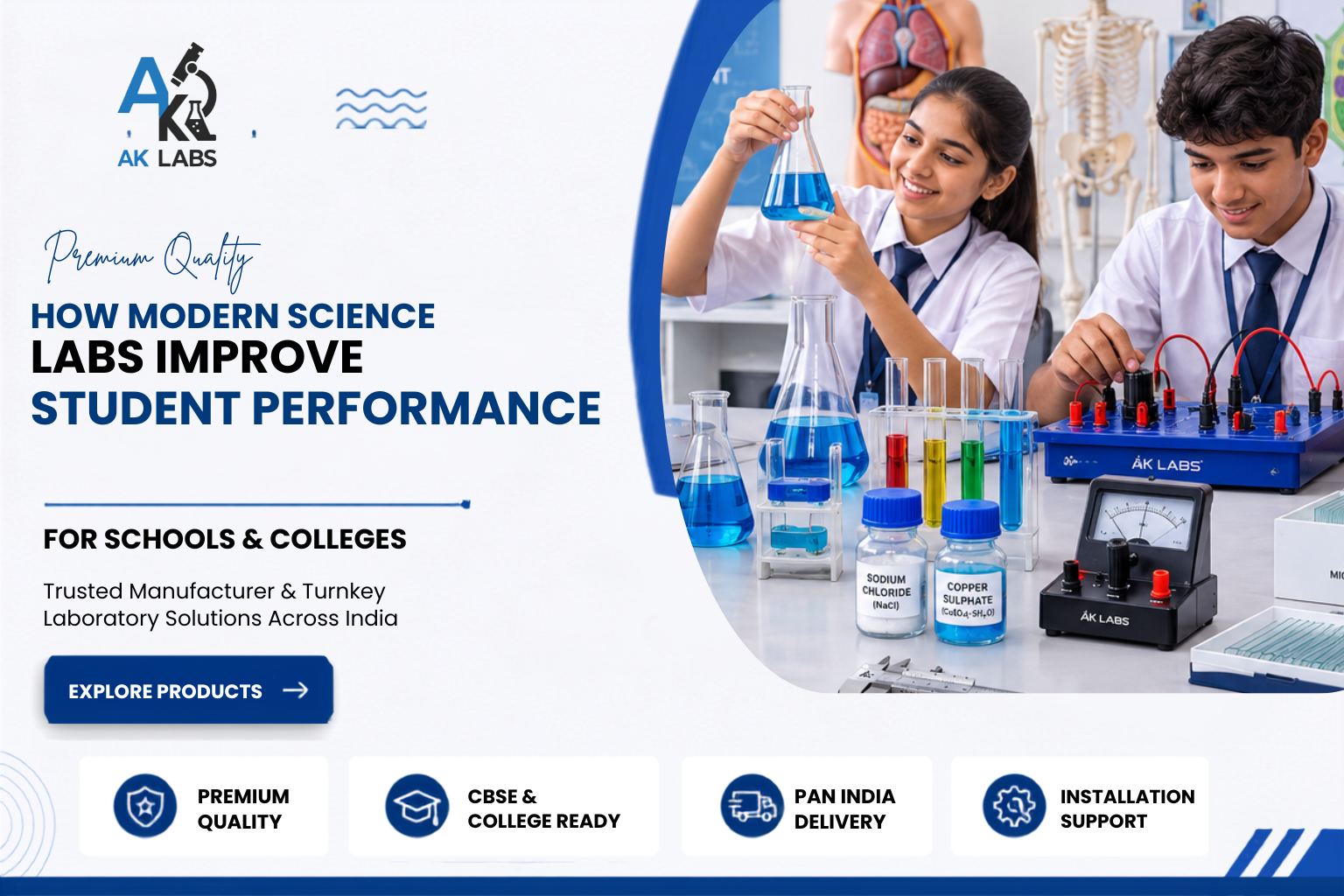
Science becomes more interesting when students can perform experiments themselves.
A properly equipped school science laboratory can provide students with opportunities to:
- Observe scientific phenomena
- Perform experiments
- Take measurements
- Record observations
- Compare results
- Discuss conclusions
Physics, Chemistry, and Biology practical activities can help students connect concepts taught in classrooms with observable results.
2. Encourage Learning Through Science Kits
Science kits can make practical learning possible even beyond regular laboratory sessions.
Students can use activity-based kits to explore topics through:
- Experiments
- Working models
- Demonstrations
- Simple projects
- Observation activities
- Problem-solving exercises
Teachers can also use these resources for classroom demonstrations, science activities, exhibitions, and project-based learning.
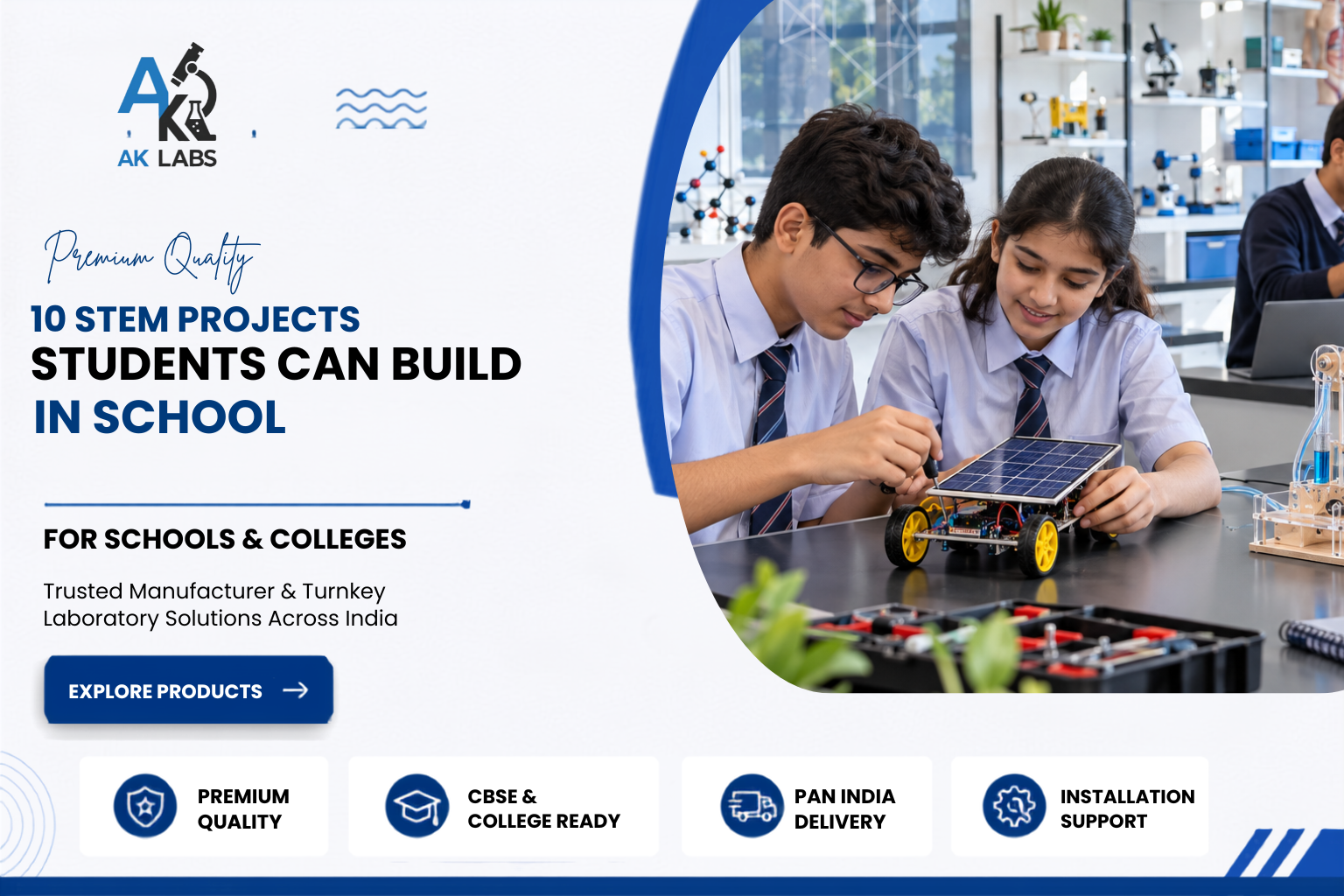
3. Introduce STEM Through Hands-On Projects
STEM education combines Science, Technology, Engineering, and Mathematics to encourage students to solve practical problems.
STEM activities can involve:
- Building simple working models
- Electronics
- Basic coding
- Robotics
- Engineering challenges
- Design projects
- DIY experiments
The objective is not simply to use technology but to encourage students to understand how things work and how they can be improved.
4. Make Mathematics More Interactive
Mathematics can sometimes appear abstract when students only work with formulas and numbers.
Activity-based Mathematics learning allows students to understand concepts through physical models and demonstrations.
Maths kits and activity resources can help students explore:
- Geometry
- Measurement
- Fractions
- Algebra
- Probability
- Shapes
- Patterns
- Mathematical relationships
Hands-on activities can make mathematical concepts easier to visualize and discuss.
5. Encourage Junior Science Activities
Young learners are naturally curious about how things work.
Junior science activities can introduce students to scientific thinking through age-appropriate experiments and models.
Instead of simply giving students an answer, teachers can encourage them to:
Observe → Question → Experiment → Record → Understand
This process helps build curiosity from an early stage.
6. Build Interest in Robotics and Technology
Technology-based activities can introduce students to engineering and computational thinking.
Robotics and technology projects can help students explore:
- Sensors
- Circuits
- Motors
- Automation
- Programming
- Mechanical systems
- Problem-solving
Such activities can also provide students with opportunities to work in teams and develop project-management skills.
7. Use Educational Models for Better Understanding
Some scientific concepts are difficult to understand through two-dimensional diagrams alone.
Three-dimensional educational models can help students visualize structures and processes.
For example:
- Human anatomy models can support Biology lessons
- Working Physics models can demonstrate scientific principles
- Geographical models can explain physical features
- Astronomy models can illustrate celestial concepts
Models can be particularly useful during classroom demonstrations and group activities.
8. Introduce Astronomy and Space Science
Astronomy can encourage students to explore questions about the Earth, Moon, planets, stars, and the wider universe.
Schools can introduce astronomy through:
- Solar system models
- Astronomy kits
- Telescopes
- Space-related educational activities
- Demonstration models
- Observation projects
These activities can connect Physics, Mathematics, Geography, and technology in an engaging way.
9. Connect Geography With Practical Learning
Geography is another subject where models and visual learning resources can be extremely useful.
Students can explore concepts such as:
- Landforms
- Maps
- Weather
- Climate
- Earth structure
- Natural resources
- Solar system and Earth sciences
Models, charts, maps, and activity-based resources can help students visualize concepts that are otherwise difficult to observe directly.
10. Create Opportunities for Science Exhibitions
Science exhibitions provide students with an opportunity to demonstrate what they have learned.
Students can present:
- Working models
- Science experiments
- STEM projects
- Robotics projects
- Mathematics models
- Environmental projects
- Astronomy projects
These activities encourage students to explain their ideas, answer questions, and collaborate with classmates.
11. Give Teachers the Right Learning Resources
Practical education also depends on teachers having suitable resources.
Teachers can use laboratory equipment, educational kits, models, charts, and demonstration products to:
- Explain difficult concepts
- Demonstrate experiments
- Conduct classroom activities
- Organize project work
- Support different learning styles
The right resources can make lessons more interactive without replacing the teacher's role.
12. Create a Balanced Practical Learning Environment
A strong practical learning programme does not depend on one type of equipment.
Schools can create a balanced environment by combining:
Science
Physics, Chemistry, Biology and laboratory experiments
Mathematics
Activity-based Maths kits and models
STEM
DIY projects, engineering activities and innovation
Technology
Robotics and electronics
Astronomy
Models and observation activities
Geography
Maps, models and visual learning resources
This creates multiple opportunities for students to discover areas that interest them.
How AK Labs Supports Practical Learning
AK Labs works with educational institutions to provide scientific equipment, educational models, activity-based learning resources, and laboratory solutions.
The focus is on creating learning environments where students can observe, experiment, build, and understand.
AK Labs' educational solutions cover areas such as:
- Physics Laboratory Equipment
- Chemistry Laboratory Equipment
- Biology Laboratory Equipment
- Science Learning Kits
- STEM & DIY Learning Kits
- Mathematics Learning Resources
- Robotics & Technology Activities
- Astronomy & Geography Learning Resources
- Educational Models
- Laboratory Furniture
- Complete Laboratory Solutions
Schools can select resources according to their curriculum, student requirements, available facilities, and practical learning objectives.
Building a Future-Ready Learning Environment
Modern education is increasingly focused on developing skills alongside subject knowledge.
When students participate in experiments, projects, demonstrations, and hands-on activities, they get opportunities to develop:
- Critical thinking
- Observation
- Creativity
- Communication
- Collaboration
- Problem-solving
- Scientific reasoning
The goal is to create an environment where students are encouraged to learn by doing.
Conclusion
Practical and experiential learning can make education more engaging by giving students opportunities to apply classroom concepts in real situations.
From science laboratories and educational kits to STEM projects, Mathematics activities, robotics, astronomy, and educational models, schools can create diverse learning experiences that encourage curiosity and independent thinking.
For institutions looking to strengthen their practical learning infrastructure, AK Labs provides scientific equipment, educational learning resources, models, and laboratory solutions designed to support hands-on education.
Because when students get the opportunity to explore, experiment, and create, learning becomes an experience—not just a lesson.
Frequently Asked Questions
Why is practical learning important for school students?
Practical learning allows students to apply theoretical concepts through experiments, activities, models, and projects, helping them develop observation and problem-solving skills.
What resources can schools use for experiential learning?
Schools can use laboratory equipment, science kits, STEM kits, Mathematics kits, educational models, robotics resources, astronomy equipment, charts, and project-based learning materials.
How can STEM activities benefit students?
STEM activities encourage students to combine scientific knowledge with design, technology, mathematics, and problem-solving.
Does AK Labs provide educational learning resources?
Yes. AK Labs provides scientific equipment, educational models, learning kits, STEM resources, laboratory furniture, and complete laboratory solutions for educational institutions.
Can schools customize their laboratory and learning requirements?
Laboratory and educational requirements can be planned according to the institution's available space, student requirements, curriculum, and specific learning objectives.