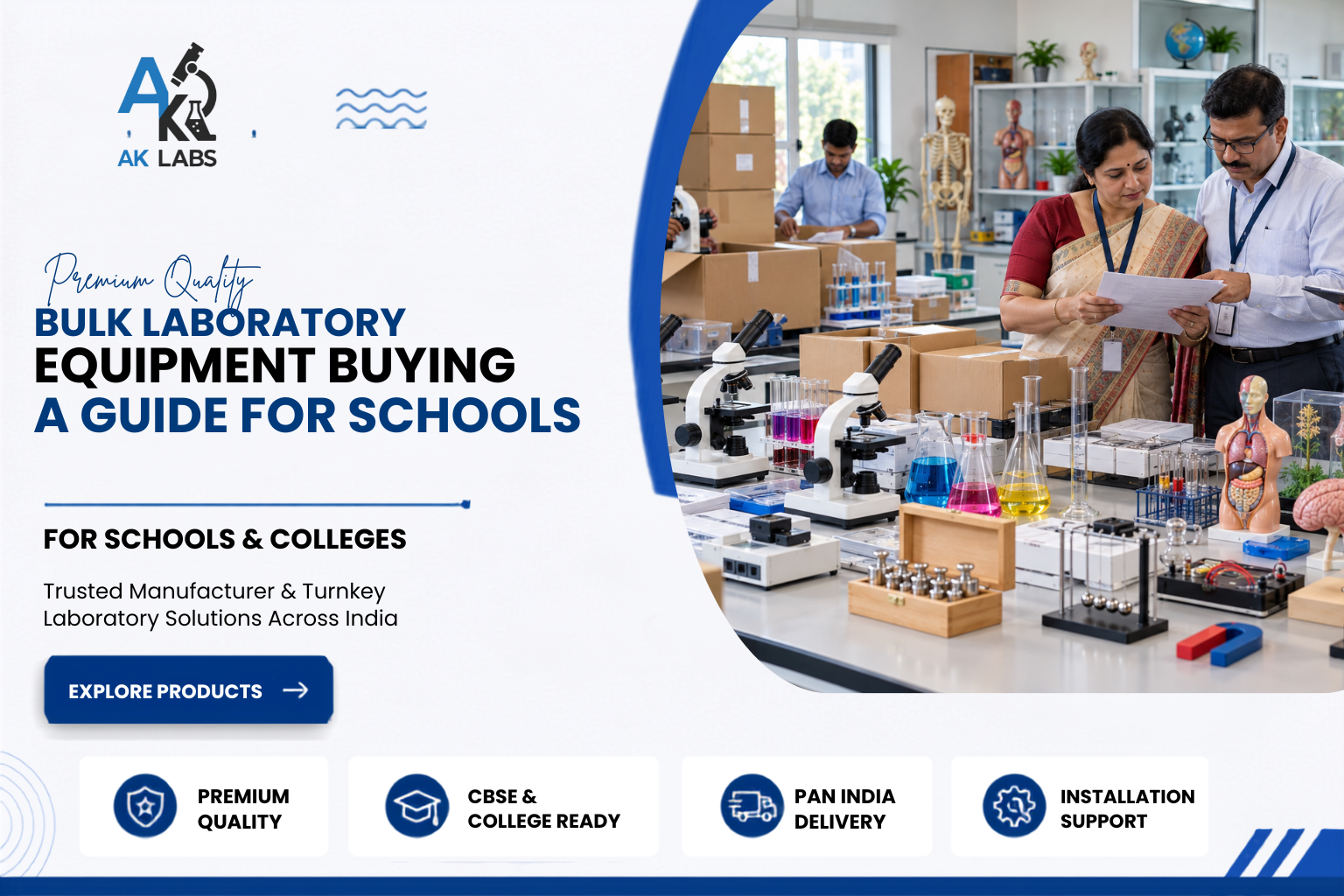
Before purchasing laboratory equipment, schools should evaluate quality, specifications, safety, supplier reliability, and overall value. Here are 5 important things to check before approving a lab purchase.
Setting up or upgrading a school laboratory is an important investment. From basic laboratory glassware to microscopes, Physics apparatus, Chemistry equipment, Biology models, and STEM learning kits, schools need to make sure that every purchase meets their educational and practical requirements.
Choosing laboratory equipment based only on price can sometimes lead to poor-quality products, unnecessary expenses, or equipment that does not meet the needs of students and teachers.
Before approving a laboratory equipment purchase, schools should carefully evaluate the quality, specifications, safety, supplier, and overall value of the products.
Here are five important things schools should check before approving a lab purchase.
1. Check the Quality and Durability
Laboratory equipment in schools can be used frequently by students and teachers throughout the academic year. Therefore, durability should be one of the first things considered before making a purchase.
Schools should check:
- Material and construction quality
- Durability of moving parts
- Quality of glassware and plastic components
- Finish and workmanship
- Expected service life
- Resistance to regular classroom use
For example, equipment such as microscopes, balances, laboratory stands, measuring instruments, and electrical apparatus should be sturdy enough for repeated educational use.
Why it matters:
High-quality equipment can provide reliable performance over time and may reduce the need for frequent replacement.
2. Check the Specifications and Educational Requirements
Every laboratory has different requirements. Equipment should be selected according to the school's curriculum, class level, experiments, and practical activities.
Before approving a purchase, schools should verify:
- Product specifications
- Size and capacity
- Measurement range
- Accuracy, where applicable
- Required accessories
- Power requirements
- Compatibility with existing equipment
- Intended class level
- Experiments in which the equipment will be used
For example, a Physics laboratory may require electrical instruments such as ammeters, voltmeters, galvanometers, and rheostats, while a Biology laboratory may require microscopes, slides, models, and dissection equipment.
Why it matters:
The right equipment should support the actual learning objectives of the laboratory rather than simply adding products to an inventory.
3. Check Safety Features
Safety should always be a priority when purchasing laboratory equipment for schools.
Students may have limited practical experience, so equipment should be suitable for supervised educational use and should be used according to appropriate safety procedures.
Schools should check:
- Product construction and stability
- Insulation on electrical equipment
- Safe operating procedures
- Protective features where applicable
- Heat-resistant components where required
- Availability of safety instructions
- Appropriate certifications or compliance documentation where applicable
Schools should also consider whether teachers and students can operate the equipment safely after receiving appropriate instruction.
Why it matters:
Properly selected equipment, combined with appropriate supervision and safety procedures, helps create a safer practical learning environment.
4. Check the Supplier's Reliability and Support
The supplier is just as important as the equipment itself.
Before approving a purchase, schools should research the supplier and evaluate their ability to provide appropriate products and after-sales support.
Consider:
- Supplier experience
- Product range
- Warranty terms
- Installation support, if required
- Technical assistance
- Availability of spare parts
- Repair or service support
- Delivery timelines
- Customer reviews and references
- Proper documentation and invoicing
A supplier offering a wide range of laboratory equipment can also make it easier for schools to source products for different departments from one place.
Why it matters:
Good supplier support can be valuable if equipment requires installation, servicing, replacement parts, or technical assistance after purchase.
5. Check the Total Value, Not Just the Price
The cheapest product is not always the most cost-effective choice.
Schools should consider the total value of the purchase, including:
- Product quality
- Expected lifespan
- Warranty
- Maintenance requirements
- Accessories included
- Installation costs
- Service support
- Replacement parts
- Delivery costs
- Long-term usability
For example, purchasing a slightly more durable instrument may provide better value if it can be used reliably for many years.
Schools should also compare quotations carefully to ensure that different suppliers are being evaluated on a like-for-like basis.
Why it matters:
Looking at total value helps schools make purchasing decisions that balance budget, quality, safety, and long-term educational requirements.
Bonus: Check the Quotation Carefully
Before giving final approval, schools should review the laboratory equipment quotation line by line.
A quotation should clearly mention:
- Product name
- Model or specification
- Quantity
- Unit price
- Applicable taxes
- Delivery charges
- Warranty
- Delivery timeline
- Included accessories
- Terms and conditions
If something is unclear, ask the supplier for clarification before approving the purchase.
Laboratory Purchase Checklist
Schools can use this quick checklist before approving a laboratory equipment purchase:
| Check | What to Verify |
|---|---|
| Quality | Material, construction and durability |
| Specifications | Size, capacity, accuracy and compatibility |
| Safety | Safe operation and applicable documentation |
| Supplier | Experience, warranty and after-sales support |
| Value | Price, lifespan, maintenance and total cost |
| Quotation | Quantity, taxes, delivery and terms |
Why Choosing the Right Laboratory Equipment Matters
A laboratory is more than a room filled with equipment. It is a learning environment where students develop practical skills, conduct experiments, observe results, and connect theoretical concepts with real-world applications.
Choosing the right equipment can help teachers conduct practical lessons more effectively and give students better opportunities for hands-on learning.
A well-planned purchase should therefore consider educational requirements, product quality, safety, durability, supplier support, and long-term value.
Conclusion
Approving a laboratory equipment purchase requires more than comparing prices. Schools should carefully evaluate the quality, specifications, safety, supplier reliability, and total value of every purchase.
Taking the time to check these five areas can help schools make informed purchasing decisions and build laboratories that support practical science education for years to come.
Whether you are setting up a new laboratory or upgrading an existing one, choosing the right equipment is an investment in better practical learning.
AK Labs provides scientific equipment, educational laboratory equipment, STEM learning models, and laboratory solutions for schools, colleges, and educational institutions.
Frequently Asked Questions (FAQs)
1. What should schools consider before purchasing laboratory equipment?
Schools should consider product quality, specifications, safety, supplier reliability, warranty, after-sales support, and overall value before purchasing laboratory equipment.
2. Is the cheapest laboratory equipment always the best choice?
Not necessarily. Schools should consider durability, performance, warranty, maintenance, service support, and expected lifespan rather than comparing price alone.
3. Why is supplier reliability important when purchasing lab equipment?
A reliable supplier can provide proper documentation, warranty support, technical assistance, spare parts, servicing, and help with installation where required.
4. How can schools check the quality of laboratory equipment?
Schools can review product specifications, materials, construction, manufacturer information, warranty terms, applicable certifications or documentation, and supplier reputation.
5. What should be included in a laboratory equipment quotation?
A quotation should clearly specify the product name, model/specifications, quantity, pricing, applicable taxes, delivery details, warranty, accessories, and relevant terms and conditions.
6. Why should schools check laboratory equipment specifications?
Specifications help schools determine whether the equipment is suitable for their curriculum, experiments, class levels, measurement requirements, and existing laboratory setup.
7. Should schools consider after-sales service when buying lab equipment?
Yes. After-sales service can be important for equipment that requires installation, calibration, maintenance, technical assistance, or replacement parts.
8. How can schools compare laboratory equipment quotations?
Schools should compare quotations on a like-for-like basis, considering specifications, quantities, accessories, warranty, delivery, taxes, service support, and total cost—not just the quoted unit price.